Walk
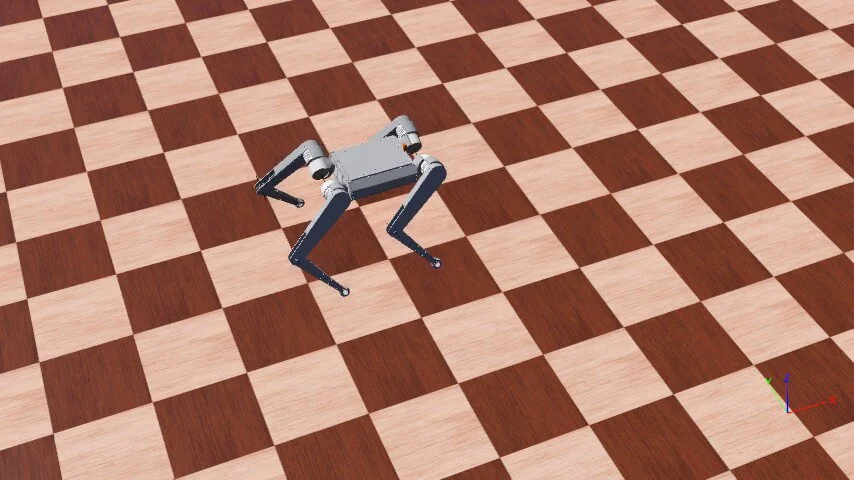
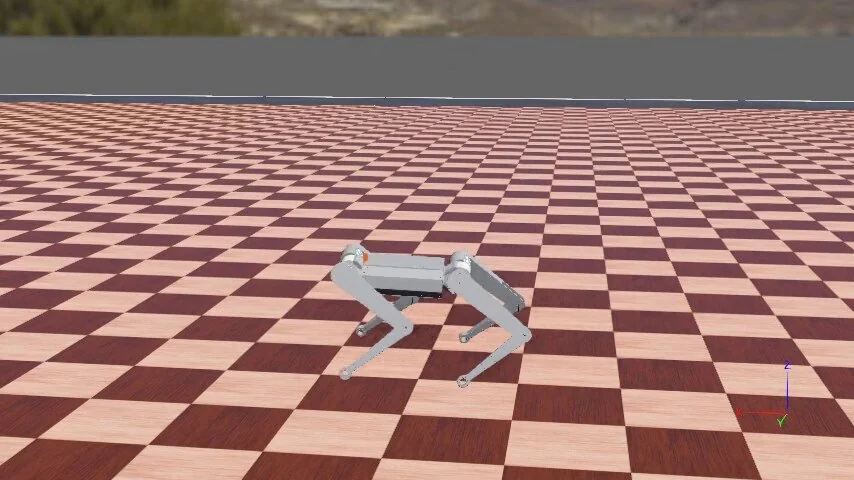
A static walk cycle keeps three legs supporting the body while one leg swings.
03 / Undergraduate thesis
An undergraduate control project that turns a quadruped model, kinematics, foot trajectories, and gait timing into a reproducible Webots simulation.
01 Scope & outcome
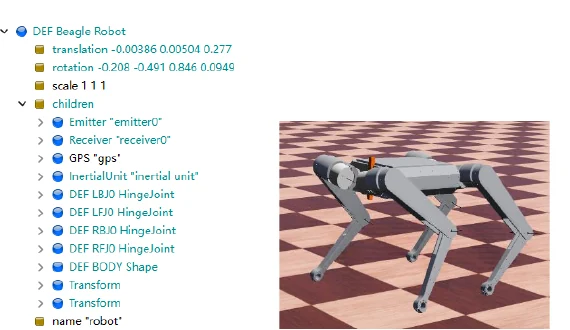
I built a virtual quadruped model in Webots from a physical-prototype reference, derived forward and inverse kinematics, and validated planned gaits in simulation. The hardware work included power-board soldering and motor debugging; the physical robot and complete main-control integration remained unfinished.
02 Control pipeline
03 Foot trajectory decision
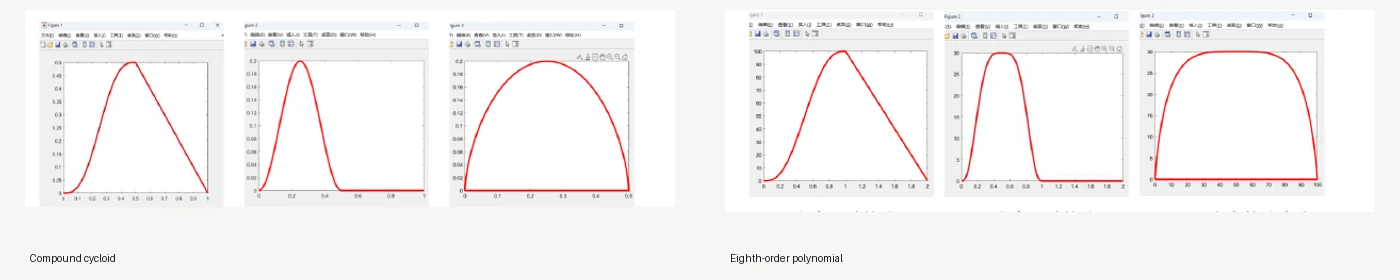
I compared compound-cycloid and eighth-order polynomial foot trajectories with MATLAB plots and Webots runs. The thesis reports the compound-cycloid path produced the more stable simulation behaviour; this is a qualitative simulation finding, not a benchmark claim.
04 Gait implementations
A static walk cycle keeps three legs supporting the body while one leg swings.
Diagonal leg pairs alternate swing and support phases for forward and backward motion.
The same phase structure is adapted by changing the lateral foot displacement.
Leg targets are transformed around the body centre to create in-place turning.
The four legs are scheduled together with a shared lift trajectory.
05 Simulation evidence
06 Motion demonstrations
07 Reproducible simulation settings
0.4 s gait period
0.8 s gait period
0.25 s gait period
10 cm lift height and 11 cm step length
08 Limits & next steps
09 Tools & responsibility
Webots · C · MATLAB · Forward/inverse kinematics · Compound cycloid · Gait planning
Back to selected projects